
dr.SushmaYadav
First Pediatric Dentist in Rewari
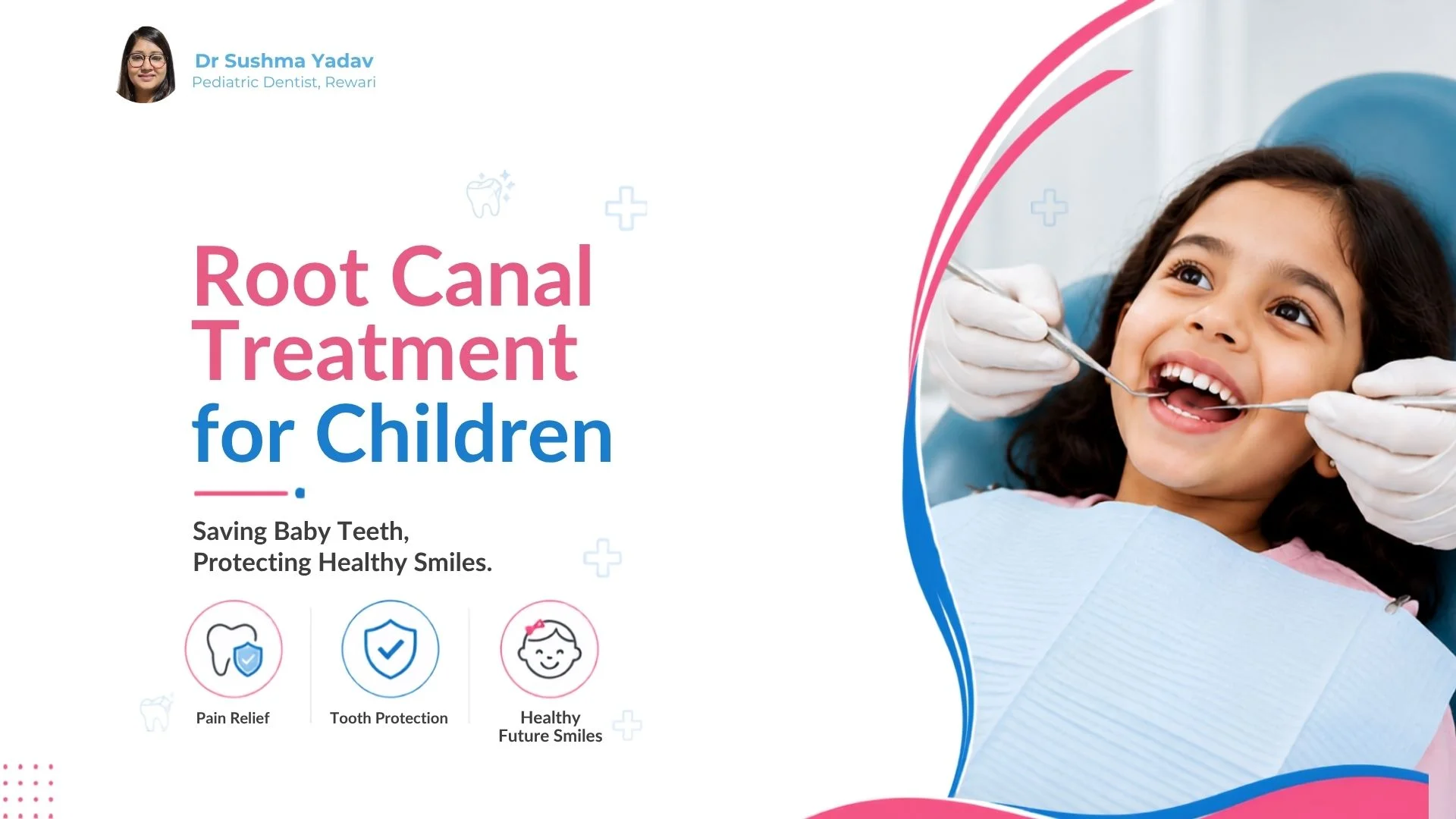
When parents hear that their child needs a root canal treatment, the first question is often, “Why treat a baby tooth if it is going to fall out anyway?”
Baby teeth are important for much more than just chewing. They help children eat comfortably, support speech development, and maintain space for the developing permanent teeth. When a primary tooth has extensive decay or damage affecting the pulp, appropriate pulp therapy may help preserve the tooth when it is restorable.
At Dr. Sushma Yadav’s Children Dental Care in Rewari, children receive dental care based on their age, tooth development, oral health, and individual treatment needs.
The inside of a tooth contains soft tissue called the dental pulp, which contains nerves and blood vessels. Deep dental decay or trauma can affect this tissue.
When the pulp of a primary tooth becomes irreversibly inflamed or loses its vitality, a pediatric dentist may recommend pulp therapy. In a non-vital primary tooth, the procedure is commonly called a pulpectomy.
The treatment involves removing the affected pulp tissue, cleaning the inside of the tooth, filling it with an appropriate material, and restoring the tooth.
For parents, this is often simply referred to as RCT for children or baby tooth root canal treatment.
Deep tooth decay is one of the common reasons a child may require pulp treatment. Dental trauma can also affect the pulp.
Depending on the condition of the tooth, treatment may be considered when there is:
The treatment selected depends on the pulp condition, clinical examination, dental X-rays when required, the child’s age and development, and whether the tooth can be restored.
Primary teeth have an important role during childhood.
They help children:
Chew food properly: Healthy teeth make eating easier and more comfortable.
Develop speech: Primary teeth contribute to normal speech development.
Maintain space: Baby teeth help maintain the space needed for permanent teeth developing underneath.
Support oral development: Healthy primary teeth contribute to normal development of the child’s mouth.
For these reasons, preserving a primary tooth may be beneficial when the tooth is restorable and treatment is appropriate. The American Academy of Pediatric Dentistry recommends considering the value and restorability of the tooth along with available alternatives when deciding on pulp therapy.
The exact procedure varies according to the tooth and its condition, but treatment generally involves several important steps.
The pediatric dentist examines the child’s tooth and overall oral health. Dental X-rays may be recommended to understand the condition of the tooth and surrounding structures.
Appropriate local anesthesia is used during dental treatment to keep the treatment area numb. Pediatric dental care also involves age-appropriate communication and behavior guidance to help children feel comfortable.
The diseased or non-vital pulp tissue is removed from inside the tooth.
The internal areas of the tooth are cleaned and prepared for the appropriate filling material.
The canals are filled with a material suitable for primary teeth. The tooth is then restored to help it function properly.
Modern dental treatment uses local anesthesia to keep the treatment area numb. The goal of pediatric dentistry is to make treatment as comfortable as possible. Children also respond differently to dental treatment. A calm environment, simple explanations, patience, and appropriate behavior guidance can help create a more positive dental experience.
After treatment, some children may experience temporary tenderness or sensitivity. Parents should follow the instructions provided by their pediatric dentist regarding eating, oral hygiene, and follow-up care.
Not every cavity requires root canal treatment. The treatment depends on how deep the decay is and whether the dental pulp is affected. Depending on the diagnosis, treatment may include preventive care, a filling, pulp therapy such as pulpotomy, pulpectomy, or another appropriate option.
This is why an early dental examination is important. Treating dental decay before it reaches the pulp can sometimes allow for simpler treatment.
After pulp therapy, the tooth needs an appropriate restoration.
In primary teeth with significant loss of tooth structure, a dental crown or cap may be recommended to restore the tooth and provide additional protection.
The type of restoration depends on the amount of remaining tooth structure, the tooth involved, and the child’s individual dental needs.
In suitable cases, yes. The objective of pediatric pulp therapy is to treat the affected pulp while preserving a restorable primary tooth and maintaining its function until its natural exfoliation. The decision depends on the condition of the tooth and surrounding tissues.
However, not every primary tooth can or should be preserved. If a tooth is not restorable or other clinical factors make preservation unsuitable, extraction may be considered.
Good dental habits begin at home.
Parents can support their child’s oral health by:
Regular dental examinations can help monitor tooth development and identify dental problems at an earlier stage.
Children need dental care that considers their teeth, growth, development, and comfort.
At Dr. Sushma Yadav’s Children Dental Care, Rewari, pediatric dental treatment focuses on maintaining healthy primary and permanent teeth through preventive care and appropriate treatment. Services may include children’s dental checkups, cavity treatment, pulp therapy, pediatric RCT, dental crowns, space maintainers, and other age-appropriate dental treatments.
For parents searching for root canal treatment for children in Rewari, pediatric RCT in Rewari, or a pediatric dentist in Rewari, understanding the treatment and its purpose can make dental decisions easier and more informed.
Children can require pulp therapy when a primary tooth develops significant decay or pulp involvement. The appropriate treatment depends on the child’s dental condition rather than age alone.
Yes. Pulp therapy can be performed on primary teeth when clinically appropriate. For non-vital primary teeth, the procedure is commonly called a pulpectomy.
Not necessarily. Treatment depends on the tooth’s condition, pulp status, restorability, and the child’s overall dental development. In some cases, extraction or another pulp treatment may be more appropriate.
A primary tooth that has undergone extensive treatment may have reduced tooth structure. A crown can help restore its shape and function and protect the remaining tooth structure.
Eating instructions depend on the treatment and restoration. The pediatric dentist will provide specific guidance based on the child’s tooth and procedure.

