
dr.SushmaYadav
First Pediatric Dentist in Rewari
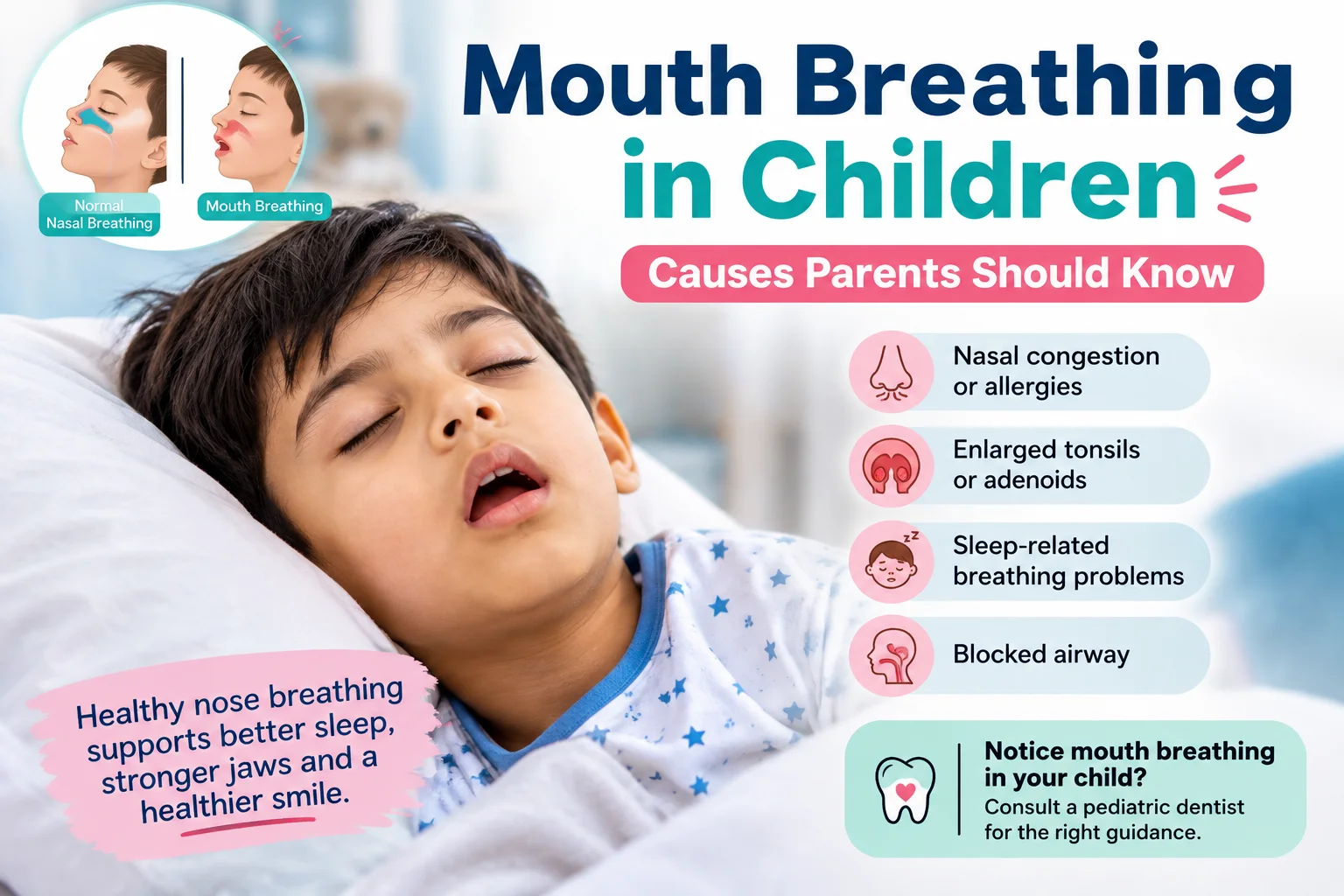
Have you noticed your child sleeping with their mouth open? Occasional mouth breathing may happen when a child has a blocked nose. However, if your child regularly breathes through the mouth while sleeping, it is worth paying attention to the pattern.
Mouth breathing in children can have different causes. Nasal congestion, allergies, enlarged tonsils or adenoids and certain airway problems can make it harder for a child to breathe comfortably through the nose.
Sometimes, mouth breathing may also occur along with snoring or other sleep-related breathing symptoms. Therefore, parents should look at the complete picture rather than assuming that sleeping with an open mouth is simply a habit.
Mouth breathing means a child is breathing primarily through the mouth instead of the nose.
Children normally breathe through their nose. The nose helps filter, warm and humidify the air before it reaches the lower airways.
When nasal breathing becomes difficult, a child may naturally start breathing through the mouth to get enough air.
If this happens only during a cold or temporary nasal blockage, it may settle once the child feels better. However, persistent mouth breathing in children deserves proper evaluation.
There is not always one single reason.
Several factors can make nasal breathing difficult during sleep.
A cold, allergy or nasal congestion can make it difficult for a child to breathe through the nose.
As a result, the child may open their mouth while sleeping.
Temporary congestion usually improves as the underlying problem settles. However, frequent or long-lasting congestion should be discussed with a pediatrician.
Enlarged tonsils or adenoids can narrow the upper airway.
Children with enlarged adenoids may breathe through their mouth, have a blocked-sounding voice or snore at night. In some children, enlarged tonsils and adenoids can also contribute to sleep-disordered breathing.
If your child regularly snores, sleeps restlessly or seems to struggle with breathing at night, speak with a healthcare professional.
Allergies can cause nasal congestion and make comfortable nose breathing more difficult.
A child may then start breathing through the mouth, particularly at night.
If you notice a pattern of blocked nose, sneezing, itchy eyes and mouth breathing, discuss the symptoms with your child’s pediatrician.
Mouth breathing can sometimes be one of the signs associated with sleep-disordered breathing.
Other signs may include loud snoring, pauses in breathing, gasping, restless sleep, unusual sleeping positions and daytime attention or behaviour changes.
This does not mean that every child who sleeps with their mouth open has sleep apnea. However, persistent symptoms should not be ignored.
It is often easier to notice mouth breathing while the child is asleep.
Parents may notice:
Some children may also show daytime signs if their sleep is repeatedly disturbed.
The American Academy of Pediatric Dentistry recommends screening children for sleep-related breathing disorders and referring children for medical assessment when a sleep-related breathing disorder is suspected.
This is an important question for parents.
Persistent mouth breathing can be associated with changes in oral function and the way the tongue and surrounding muscles work. However, the effect varies from child to child, and mouth breathing should not automatically be blamed for every dental or facial change.
A pediatric dentist can examine the child’s teeth, bite, jaw development and oral habits as part of a complete assessment.
That is why early evaluation can be helpful when mouth breathing continues.
It can be associated with sleep-related breathing problems, especially when a child also snores or has pauses in breathing.
Sleep-disordered breathing can interfere with normal sleep. In children, untreated obstructive sleep apnea has been associated with problems such as daytime behavioural changes, attention difficulties and impaired growth.
Again, mouth breathing alone does not mean your child has sleep apnea.
The important thing is to look for multiple symptoms together.
Consider discussing the issue with a healthcare professional if your child regularly:
Breathing pauses, gasping or significant breathing difficulty during sleep deserve prompt medical attention.
Start by observing the pattern.
Notice when your child breathes through the mouth. Check whether it happens only during a cold or whether it continues regularly.
You can also note whether your child snores, wakes frequently or appears uncomfortable while sleeping.
Next, discuss persistent symptoms with your child’s pediatrician or an appropriate healthcare professional. If there are concerns about the child’s teeth, bite, oral habits or jaw development, a pediatric dental evaluation can also be useful.
A dentist can assess the child’s oral health and identify whether further evaluation may be appropriate.
A dentist in Rewari can examine your child’s teeth, bite, oral habits and developing jaws when mouth breathing is a concern.
A pediatric dentist can also look for signs that may need further assessment and guide parents about the next step.
If symptoms suggest a possible sleep-related breathing disorder, dental evaluation should not replace medical assessment. The American Academy of Pediatric Dentistry recommends referral to an appropriate medical professional when obstructive sleep apnea is suspected.
A child sleeping with their mouth open occasionally is not necessarily a reason for concern.
However, persistent mouth breathing in children, especially when accompanied by snoring, nasal blockage, restless sleep or breathing pauses, deserves attention.
Instead of treating mouth breathing as just a habit, parents should look for the underlying reason.
Early evaluation can help identify whether the issue is related to nasal congestion, allergies, enlarged tonsils or adenoids, sleep-related breathing problems or another cause.
If you have noticed ongoing mouth breathing in your child, consider discussing it with a pediatrician and, when appropriate, a pediatric dentist in Rewari for an oral and dental assessment.

